Monday, June 14, 2021

Our Trip to Expo '67


Although we knew we were going on a trip, none of us really had much of an idea what a world's fair was, other than it would be bigger than our wonderful Dubuque County fairs that we went to each summer.  We knew it would have people from all over the world attending and that we were headed to Canada.   

With six children in our family by the summer of 1967, most people that knew our family, also knew that we traveled by station wagon which was one of few vehicles that would carry 8 people.  By that point in my young life, we were on station wagon number two; the red Chevy Impala station wagon with 3 rows of seats.  The back bench seat would lay down flat and created what we called "the way back".  Dad had cut a piece of foam and sewed a cover for it to make the area more comfortable.  This was in the years when seat belts were still optional, and we did not use them on any kind of a regular basis.  Of course, there were no seat belts in "the way back" and the car was pretty much a free-for-all with children switching seats, climbing back and forth, playing games, trying to sleep, teasing a sibling and almost anything else that we could think of to amuse ourselves.

Our family also did a lot of short distance traveling to visit relatives in Wisconsin and to go camping.  We had grown up and out of our original tent and into a tent trailer.  Dad, who was incredibly talented with carpentry work had fashioned two long, low-lying storage chests that sat to the one side of the trailer entrance and then made a table that would serve both as an eating or entertainment area when the weather was bad and would drop down to create another large sleeping area in the center of the trailer that a mattress would lay on top of.  The extra bed allowed 6 of us to sleep in the trailer. There was a lot of crawling over top of each other to get in the far bed, get out of the bed to go to the bathroom and back in again during the middle of the night.  I am sure my parents did not get a lot of sleep, but as kids it mostly did not bother us much to be the path to freedom for another sibling unless they stepped on our stomach or hit our nose with an elbow on their way.

That summer there was a lot of preparation for the trip with Mom menu planning and purchasing everything we would need for a couple of weeks and Dad getting the trailer ready and crafting a storage roof box for the top of the station wagon.  

The day before we left, we took the two youngest, Lisa who was almost 3 and Jill who was still an infant, to my grandparents' home as they were not going with us.  That in itself was a revelation because the Von Fumetti family usually traveled en masse!  Finally in the late afternoon, early that August in 1967, the 4 oldest children; Karla (10), Viki (9), Lynn (6) and Mark (5) climbed into the car over pillows, toys, games and whatever we thought we needed to amuse ourselves.  Dad's only rule then, as it would always be, was that if we took it, we had to carry it.  He would not and did not.  We learned early to pack light!  There is no telling who took up what position in the car that afternoon but assuredly it had changed dozens of times before we made it to Canada.  

Click on images to view in a larger format
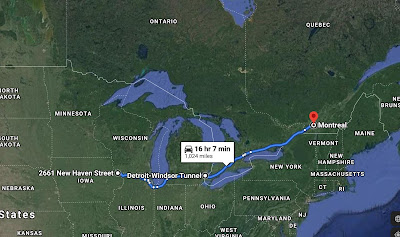
The trip from Dubuque to Montreal was over 1,000 miles.  That was also the days of highway speeds anywhere from 60 to 100 miles per hour but largely two-lane roads.  Dad and Mom drove straight through the night to Canada with only brief stops for gas and eating.  That is until we reached the Canadian border crossing at Windsor, Canada after traveling through the international tunnel from Detroit.  

Mom had packed enough food to see us largely through our time in Canada.  Among all the food was a case of fresh peaches, each hand-wrapped to protect them.  Fresh peaches in Iowa were a brief summer treat and not inexpensive.  When it was our turn to go through the border gates flying the Canadian flags, one of the questions that was asked was did we have any fresh produce in the car?  I am not sure if the peaches were in clear view, or they were the only fresh produce Mom had packed but we got flagged for the peaches.  The border guard was adamant that they could not be taken into Canada.  Mom was equally adamant that we were not going to leave them behind.  And we did not.  We pulled the car over to the side and were instructed to eat those peaches!  While enjoying the peaches with juice running down our arms and chins, we watched other cars get directed to different areas.  Some were nearly emptied with their belongings all out on the ground, hubcaps removed, etc. while the border guards looked for contraband.  Dad and Mom with 4 small faces sitting behind them in the car must have been deemed honest as the only thing that slowed us down were those peaches.  We all cheered as we finally drove through the gate into Canada.  

From there it was not a long drive to a campground where we would spend the first night and we finally got out of the car that mid-morning for more than a short stop.  Dad set up the camper and he and Mom pretty much collapsed for several hours catching some much-needed rest.  With the general childhood freedoms of the day, the four of us roamed the campground and entertained ourselves finding the playground, sand pits, and restrooms with Viki and I keeping an eye on Lynn and Mark. We had a quiet night in the campground and got up the next morning, packed and headed for Montreal.

Montreal had campgrounds set up for Expo '67 all over the surrounding area.  We were in a treeless field of sorts with campers and tents in long rows.  It was near the edge of Montreal somewhere and full of children to play with in the short hours we were there and not at the fair.  I met a new friend, Cheryl Raniere, from Halifax, Nova Scotia and we were pen pals for many years after leaving Montreal and I am still in contact with her.  


A baby elephant was being housed at the edge of our campground near the edge of town.  We enjoyed seeing it over the next few days and were thrilled to see the men and the young elephant again a year later in Monticello, Iowa at the Jones County Fair.

Finally, the time had come to actually go see the World's Fair.  It was not a long drive, but we entered a huge parking area that was filled with row after row of vehicles and as Dad drove up and down many rows, we had a difficult time finding a parking spot.  As we drove down yet another long line of cars without any empty spots, I saw one in the next row, yelled that I was going to "save it" and jumped out of the car without giving my startled parents any time to respond.  I dodged to the other side of the parked cars and stood in the empty spot waiting for Dad to make the long slow drive to the far end on the opposite side and head my way.  In the meantime, someone else had their eye on "my" parking spot and nosed their car into the front of the space.  I stood my ground, they eased in more, I stood my ground and smiled at them but refused to move.  They finally gave up and Dad pulled in almost the second after they backed out.


We all got out of the car and headed with excitement to see Expo '67.  There were small open air trams that picked us up and delivered us to one of the fair entrances near the United States pavilion.

The United States Pavilion, a Buckminster-Fuller geodesic dome.
Lynn, Katie, Viki, Karla and Mark.

The view in every direction was a wonder to take in.  Modern styled pavilions of every sort dotted the landscape and we read the name of different countries on the outside of some of them.  

The Cuban Pavilion (center), Venezuela (far left)

The Worlds Fair "Man the Explorer" Pavilion

The multi-flag area was the United Nations Pavilion "Place du Nations" looking out over the Saint Lawrence River.

Taking a break.
Lynn and Karla.  Kathleen, Mark and Viki.


The Canadian pavilion was the inverted pyramid to the far left with the Canadian Western Provinces pavilion in the center with the trees on top.

Time for a picture!
Mark, Viki, Lynn and Karla.


The Ontario Pavilion 

Headed to Germany's Pavilion.
Karla, Katie, Mark, Lynn, and Viki.


Worn out.
Mark, Kathleen, Lynn, Karla and Viki.


I know we saw a lot of new and exciting things over the three days we were there, but only a few have clearly taken root in my memory.  Things that stand out in my mind were the American Pavilion that had among other things escalators that were 3-4 stories high.  The largest I had ever been on was in JC Penney's in Dubuque which took you to the second floor.  They were awe inspiring as well as terrifyingly high.  There was a huge Raggedy Ann and Raggedy Andy exhibit in honor of the American author Johnny Gruelle who had created the stories and dolls. 

Inside the American Pavilion.


The multiple stories high escalators in the Geodesic Dome.

The Canadian Telephone Pavilion exhibited all sorts of new types of telephones, none of them cordless yet but intriguing all the same.  You could talk to someone and see them when you talked!  The Czechoslovakia Pavilion was full of amazing wood crafts.  They had a beautifully carved and crafted dollhouse which set a standard for doll houses that I have never seen surpassed.  We spent a lot of time looking at the beautiful woodwork and the mansion home of some incredibly lucky dolls.   Dad spent a lot of time looking at the craftmanship and how it was made.  Mom likely spent a fair amount of time keeping us corralled.   The Germany pavilion had a huge collection of every type and size of cuckoo and mechanical clocks which was entertaining, especially as the hour changed and everything started making music, cuckoo-ing, and moving.  


Time for a ride.  
Lynn and Viki.

We spent 3 days at the fair and from there headed to Quebec City and Old Quebec.  I was amazed mostly at the people who spoke a different language than we did and who I did not understand.  What I did understand was that they were incredibly rude to English speakers.  I have a clear memory of going into a casual restaurant that had menus in French.  Despite Dad having some experience with the French language 15 years earlier, none of us really could understand what we would be ordering, and the waiter refused to translate.  We all got up and left, very hungry and frustrated. 

On the move.
Old City of Quebec

The next day we went to a laundromat while still in Quebec and an older gentleman came in and visited with us while he and Mom were both doing laundry.  He had a soft-back memorial souvenir of the wedding of Queen Elizabeth and Prince Philip which he showed me and when he saw how much I enjoyed looking at it gave it to me to take home.  So at least I knew not all Quebecers were rude and mean!

Le Chateau Frontenac along the Saint Lawrence River in Old Quebec City

Antique cannon rimming the Old Port of the Old City.
Viki, Lynn, Karla, Mark

We visited the Citadel of Quebec and watched the huge military tattoo on the fort parade grounds.  It was the 100th anniversary of the Canadian Confederation which was also celebrated in 1967.  The emblem above the fort entrance below was the symbol of the centennial.  We were able to watch some impressive precision marching and music as part of the celebration which was entrancing to all of us.

Citadel of Quebec with the Centennial Logo of the Canadian Confederation
with the Military Tattoo formed of different regiments from all over Canada.


Raising the Canadian Flag

From there we headed to the Canadian side of Niagara Falls at Toronto, Ontario.  It was a beautifully landscaped park and the falls seemed impossibly big.  We all took a boat ride on the "Maid of the Mist" and took in the view from below as well as getting quite damp from the spray.  


"Maid of the Mist" at the base of the falls.

The Ontario Needle Tower adjacent to Niagara Falls.
The Von Fumetti family is the small group on the lawn!


Beautiful gardens surrounded the park at Niagara Falls.
One of the few pictures that Dad is in!
Karla, Viki, Lynn, Cyril and Mark.


Looking up at Dad from the manicured gardens.
Karla, Mark, Viki, Lynn and Katie


A few quiet moments at the end of our trip.
Viki, Karla, Lynn, Mark


I have no memories of the trip home.  More than likely, we were all worn out and slept along the way.  It was the longest trip that we took together as a family, but we continued to travel and camp most of the years that we were all growing up.  


© Karla Von Fumetti Staudt

All rights reserved. No part of this publication may be reproduced, stored on a retrieval system, or transmitted in any form or by any means – electronic, mechanical, photocopying, recording or otherwise – without prior permission of the copyright owner and publisher.


Monday, June 7, 2021

Grandma's Scrapbook

A treasured book.  Tattered pages, brittle with age; so brittle that small pieces fall off with every turn of a page.  Items are glued into place, some of them folded so that both sides can be seen where necessary.  

The story starts with the "scrapbook" itself which is a 1926 Central Electric Company hard bound catalog.  It was not new, and likely had been discarded when my grandmother, Harriet (Shookman) Kenyon picked it up and decided it would "do" as a home for her family's precious mementos that had been saved carefully over the years.  The earliest writing that can be verified is that on the inside cover page and that dates Harriet's scrapbook back to at least the fall of 1934; deep into the years of the Great Depression.  Money was scarce if it was available at all.  

Eight children were living at home on the old Kenyon homestead farm.  My grandfather, Charles Kenyon, had returned to claim back his childhood home, buying it a little at a time on a land contract in 1932 which required regular payments from little income.  Charlie and Hattie were luckier than those who dwelled "in town" as the farm had 70 acres with a large kitchen garden that was needed to feed their family.  They had enough produce to share with Charlie's Aunt Cora (Kenyon) Heser when he took the older children into Tomah each Monday to board with Cora so that they could attend school and for his father, Louis who lived with her.  

My grandfather was able to find employment in 1935 working for the newly created Works Progress Administration as a stone mason and builder which helped to bring in a small amount of much needed cash.  There often was not enough money available to buy basic, needed items, let alone something frivolous such as a scrap book.  That was the tone of the day when Harriet likely picked up the several years old catalog and put it to use.  

The scrapbook looked to have a utilitarian purpose at first with things such as her favorite recipes, handwritten and shared by family members and friends, glued in at the front pages of the book but ultimately became a repository for precious clippings, cards and mementos. 

To look at the items in the book, they were largely glued in rough order of the years and give glimpses into Harriet and Charlie's life.  

Double click any of the images to see them in a larger size.


On the inside front page, which had no printing from the catalog, Harriet recorded the 5 youngest children's shoe sizes starting in fall 1934. Shoes were purchased the next summer, then the fall of 1935, but after that went to once a year in 1936, 1937 and 1938, a stark indication of the finances of the family.  Her daughter, Kathleen, told a story of a pair of shoes that she wanted so much as a child that she pulled her toes back to make them fit when she tried them on.  She had to wear them for many months after that because there was not money to buy another pair.  Shoes were handed down where possible to the next child.  According to Harriet's records, Jimmie did not have a new pair of shoes from Fall 1935 again until Fall 1938 and it is likely that the others followed suit where possible.


After pasting in the selection of her favorite recipes, Harriet started reaching for significant mementos from her life, and from Charlie's. The Certificate of Merit was from Charlie's teacher at Pine Grove School, Jennie Shepard.  While undated, Charlie left school before he finished 8th grade in 1902 at age 13.  


This small fan is pasted in with Hattie's childhood memories.  It carries the name of Hattie's younger sister, Bernice Shookman who died at age 8 in 1906 when Hattie was 11.  This may be a memorial card from her funeral.  


Theodora Sidonsel gave Hattie this "report card" in 1903 when she was attending school in Richland County, Wisconsin prior to her family's move to Warrens in about 1905. 


Tucked in with the earlier documents is a sweet handmade valentine from Harriet and Charles' 2nd oldest daughter, Veva from 1926 when she was 7 years old.


Hattie joined the Comfort's League of Cousins, an organization associated with Comfort the magazine which was touted as "The Key to Happiness and Success in over a Million Homes".  Subscription members received the magazine which had entertaining fiction, how-to articles, a Q&A help section in which Uncle Charlie would answer questions mailed into him, and the availability of pen pals.  The League of Cousins was aimed at youth and young adults.  A similar group existed for married women. The magazine was published starting in 1888 and Hattie may have subscribed sometime after she graduated from 8th grade in 1910 and went to work as a teacher.  


This event program from the Pine Grove Public School where Lura Shookman, Hattie's sister, taught in 1912.  The musical and oral presentations would have been given by the 6–13-year-old students at the school.


Harriet received this 1922 graduation invitation from her sister, Helen Shookman.   With their parents, Samuel and Dora (Manley) Shookman's strong encouragement for education, the older 3 sisters, Lura, Ina and Harriet completed 8th grade and then teacher's training, but Helen was the first family member to have the opportunity to go to high school.  It would have been an immensely proud occasion. 


Tucked in among the graduation and wedding invitations from the early part of the century was this marriage announcement for Charles' uncle, Daniel C. Kenyon and Elizabeth Scott from 1895.   Dan and his family moved to Montana in 1898.  


Glued in with a collection of obituaries is this article, "Care of Horses in Army", written by Harriet's first cousin, Floyd Manley dated September 28, 1918. Floyd died in the Spanish Flu Pandemic two weeks later on October 14, 1918 at Camp Lee.


Baby Glen Shookman Kenyon, 3rd child and first son of Charles and Harriet, was announced to close friends and family.  He was born in 1920 with WWI over and the Depression still to come when there was money to pay for such sweet mementos.


Doris was the oldest child of Charles and Harriet.  Doris had graduated from high school in 1934 as did all her younger siblings in years to come, and went on to follow in her mother's footsteps to become a teacher.  Doris was the first of the eight children to get married.


Twins!  Great excitement when not one, but two babies were born in 1926 joining the 3 older siblings Doris, Veva and Glen.


The clippings below share news from Purdy Valley.  Harriet took up writing social news tidbits for the Tomah Journal and these are likely examples of her work although as an unpaid, but regular contributor, she never received credit by name in the paper.  The clipping at the top right reads in creative rhyme:

Purdy Valley, it brought a smile,
When the request came from you.
But glad to hear you like my style,
While reading the Journal thru and thru.
The writer has no special law,
But worth facts that interest you
Will the reader's attention draw
And we'll enjoy the work you do.


This may have been an article that reminded Hattie of her mother, Dora (Manley) Shookman who died in 1921 at the age of 54. 


Hattie had a collection of poetry and literary articles that she deemed important enough to add to her scrapbook.  Despite the very arduous lifestyle, Hattie may be giving an inclination of what she thought of the life on a farm...


This article obviously reminded Harriet of days in the past when her grandmothers, and possibly her mother used a spinning wheel to produce fiber for weaving or knitting. 


A Christmas wish for Santa Claus from young Kyle Kenyon.  I do not know if Kyle received either of his wishes.  Tradition in Charles and Harriet's family included a Christmas stocking with a large orange and apple in the toe, along with nuts in the shell and some hard candy.  All would have been treasured treats with out of season fruit and the oranges shipped to the Midwest from the far South. 


A source of extra cash for the family in the summer were Charlie's strawberries and his watermelon field.  This summer he had a prize-winning melon.


This is one of the later items glued into the scrapbook. Harriet, a mother of 8 children, surely had her work cut out for her in addition to their care and supervision.  She was responsible for all meals including making breads and cakes with only an ice box to temporarily keep a few items chilled.  She did not have an electric refrigerator until sometime after they moved off the farm in 1941.  Laundry was done either by hand, or later, with a gas-powered washing machine, and all of it was hung out to dry whether in the heat of summer or the bitter cold of winter, often freezing on the line.  Ironing was done with a cast iron heated on the burner of the stove and nearly all garments were made of fabric which needed ironing.  Harriet had responsibility for a large, nearly 1 acre, "kitchen garden" where she raised most of the families produce, the majority of which had to be canned in Wisconsin's hottest months to preserve it for the time they did not have those food items.  Most of the meat the family produced and butchered was also canned to preserve it.  This is a typewritten poem which may have been written by Harriet, or someone she knew.


The last items in Harriet's scrapbook would indicate that she did not add any new items to her collection after about 1950 when she had her first stroke.  It gives glimpses into the times that framed her life and created the woman that she became.  It was a prized possession within the family and Harriet's daughter, Helen Joy (Kenyon) Kelley inherited the scrapbook when Harriet passed on.  It was pored over by visiting family members over the years and inherited by Helen's daughter, Jean (Kelley) Gluege.  Jean had it several years and when she was downsizing gifted the nearly 90-year-old scrapbook to me to be shared as much as possible with family members, now living in a digital age.  


© Karla Von Fumetti Staudt

All rights reserved. No part of this publication may be reproduced, stored on a retrieval system, or transmitted in any form or by any means – electronic, mechanical, photocopying, recording or otherwise – without prior permission of the copyright owner and publisher.


Keziah (Gould) Purdy, 1823-1845

Once upon a time, about 1840, There was a young girl named Keziah, Who fell in love with a young man named Daniel. They got married. Within ...